
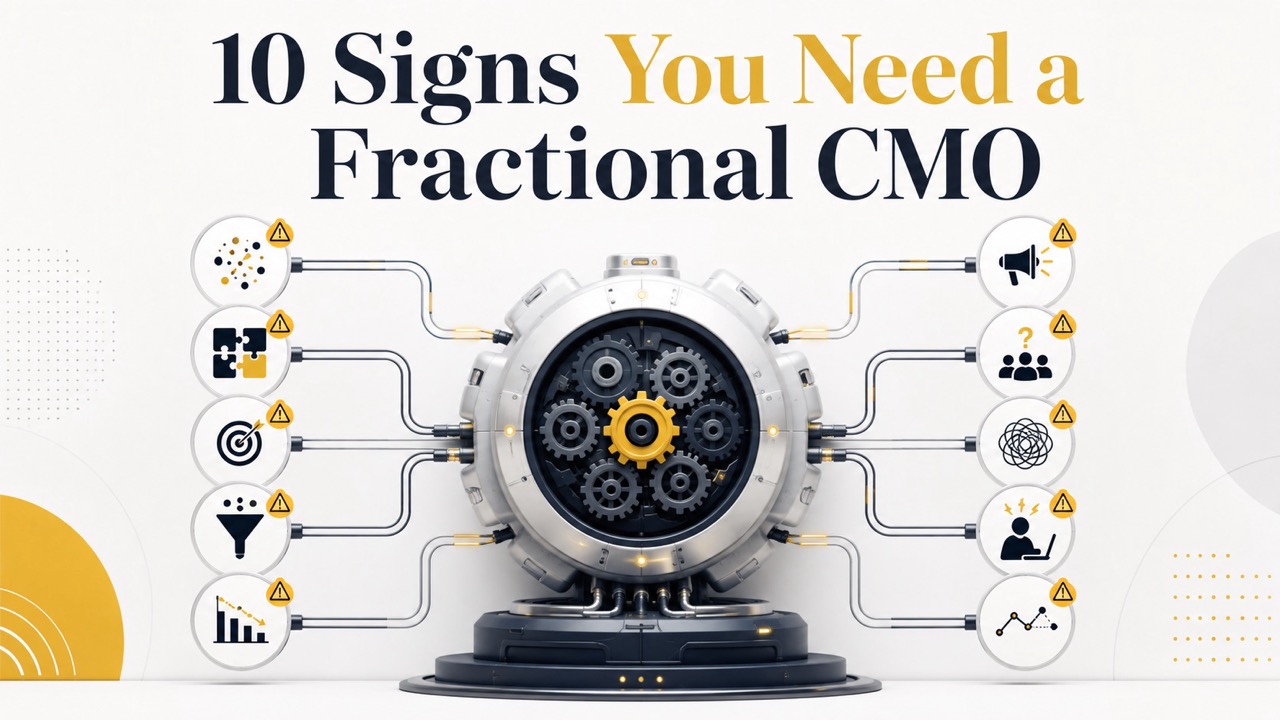
Many companies do not realize they need senior marketing leadership until marketing starts feeling chaotic.
The website is being updated.
Content is being published.
Agencies are running campaigns.
Sales is asking for more leads.
The founder is reviewing messaging.
Someone is managing social media.
Someone else is trying to improve SEO.
Activity is happening, but it is not always clear whether the different pieces are working together.
This is often the point where fractional CMO services become useful.
A fractional CMO gives a company access to experienced marketing leadership on a part time basis. The role is particularly relevant for growing businesses that need strategic direction and accountability but are not yet ready to hire a full time marketing executive.
Here are 10 signs your company may be at that stage.
1. The Founder Is Still Running Marketing
Founder involvement is normal in the early stages of a business.
The founder often understands the customer better than anyone else. They know why the product exists, what makes it different, and what early customers care about.
The problem appears when the founder becomes the permanent marketing department.
If the founder is still:
- 1Approving every campaign
- 2Writing website copy
- 3Choosing advertising channels
- 4Managing agencies
- 5Reviewing social media
- 6Deciding which events to attend
- 7Building sales decks
- 8Checking lead quality
marketing can quickly become a bottleneck.
A fractional CMO can take ownership of the marketing function while keeping the founder involved in the decisions where their knowledge matters most.
2. You Have Marketing Activity but No Clear Strategy
A busy marketing calendar is not the same as a marketing strategy.
Many companies are doing a little bit of everything:
- 1LinkedIn
- 2SEO
- 3Paid search
- 4Events
- 5Newsletters
- 6Webinars
- 7Content
- 8Outreach
- 9PR
- 10AI search optimization
The problem is that nobody has clearly decided which activities matter most and how they support revenue.
A fractional CMO can help define:
- 1Priority audiences
- 2Positioning
- 3Market focus
- 4Core messages
- 5Channel priorities
- 6Budget allocation
- 7Marketing KPIs
The goal is to reduce random activity and create a coherent system.
3. Your Positioning Is Not Clear
If salespeople describe the company one way, the website describes it another way, and customers describe it differently again, positioning may be weak.
This creates problems across nearly every marketing channel.
Weak positioning makes it harder to:
- 1Build effective campaigns
- 2Produce strong content
- 3Improve conversion
- 4Differentiate from competitors
- 5Win attention in crowded markets
- 6Generate qualified leads
A fractional CMO can help sharpen the company's category, target customer, value proposition, competitive differentiation, and message hierarchy.
4. Sales Says Marketing Leads Are Not Good Enough
This is one of the most common warning signs.
Marketing reports leads.
Sales reports that the leads are poor.
Marketing says sales does not follow up properly.
Sales says marketing does not understand the customer.
This conflict usually points to a deeper alignment problem.
A fractional CMO can help establish shared definitions around:
- 1Ideal customer profile
- 2Buyer roles
- 3Lead qualification
- 4Sales qualified opportunities
- 5Pipeline stages
- 6Attribution
- 7Follow up processes
The goal is to create one revenue system rather than two departments with separate scoreboards.
5. You Have Several Agencies but Nobody Is Managing the Whole Picture
Growing companies often accumulate agencies and freelancers over time.
You may have:
- 1An SEO agency
- 2A paid media agency
- 3A designer
- 4A PR firm
- 5A web developer
- 6A content writer
- 7A social media freelancer
Each supplier may be good at what they do.
The problem is that every specialist naturally focuses on their own area.
Someone still needs to decide which priorities deserve investment and whether the different partners are working toward the same business goals.
A fractional CMO can become that central owner.
6. Your Marketing Budget Is Growing but Confidence Is Not
Spending more money does not automatically improve marketing.
If your budget is increasing while leadership still struggles to answer questions such as:
- 1Which channels are working?
- 2Which activities contribute to pipeline?
- 3Which campaigns should we stop?
- 4Which markets deserve more investment?
- 5What should we do next quarter?
the company may have an accountability problem.
A fractional CMO can introduce better planning, performance reviews, budget discipline, and prioritization.
7. You Are Entering a New Market
International expansion creates a different marketing challenge.
The message that works in one market may not work in another.
Customer expectations may change.
Competitors may be different.
Channels may perform differently.
Sales cycles may change.
A company entering a new country may need to rethink:
- 1Positioning
- 2Localization
- 3Market research
- 4Content
- 5Partnerships
- 6Events
- 7Lead generation
- 8Sales enablement
- 9Local agencies
A fractional CMO can provide senior leadership during the expansion stage without requiring the company to immediately build a full local marketing team.
8. Your Marketing Team Needs More Senior Guidance
A capable marketing manager can execute well and still need strategic support.
This is particularly common in small B2B teams.
The internal marketer may be responsible for:
- 1Campaigns
- 2Content
- 3Social media
- 4CRM
- 5Website updates
- 6Events
- 7Reporting
But they may not have experience with broader questions such as market strategy, positioning, organizational design, budgeting, or executive alignment.
A fractional CMO can provide that senior layer while helping the existing team grow.
9. You Keep Changing Direction
One month the priority is SEO.
The next month it is paid media.
Then leadership decides to focus on webinars.
Then AI search becomes urgent.
Then a new market becomes the priority.
Constant changes create wasted work and team frustration.
Sometimes priorities should change.
The problem is when there is no framework for deciding why.
A fractional CMO can create a clearer planning process and help leadership distinguish between genuine opportunities and distractions.
10. You Know You Need Better Marketing but Are Not Ready for a Full Time CMO
This is the clearest use case.
You know marketing needs senior ownership.
But hiring a permanent executive may feel too early because:
- 1The team is still small
- 2The budget is still developing
- 3The marketing model is not yet proven
- 4The company is entering a transition stage
- 5You are unsure what type of CMO you eventually need
Fractional leadership can bridge that gap.
It gives the company access to senior experience while helping build the systems, team, and strategy that a future full time CMO may eventually inherit.
What Should a Fractional CMO Actually Do?
A strong fractional CMO should create clarity and leverage.
Typical responsibilities may include:
- 1Developing the marketing strategy
- 2Clarifying positioning
- 3Prioritizing target segments
- 4Aligning sales and marketing
- 5Building the marketing plan
- 6Managing agencies
- 7Improving reporting
- 8Reviewing marketing technology
- 9Mentoring the team
- 10Supporting hiring decisions
The exact scope should depend on the business.
Final Thoughts
A fractional CMO is most useful when the company has reached a level of complexity where marketing needs leadership, but a full time executive is not yet the right fit.
If your business recognizes several of the signs above, the problem may not be a lack of marketing activity.
The problem may be a lack of senior ownership.
Mustard Seed Solutions helps B2B technology companies create clearer marketing strategies, coordinate specialist execution, strengthen market positioning, and build flexible marketing functions around their stage of growth.