
Best GEO Tools in 2026 for Marketing, Growth, and Product Teams
The best GEO tool depends on team size and workflow. Profound is strongest for enterprise AI visibility intelligence, Peec AI is a strong choice for competitor and AI search tracking, OtterlyAI is easier for smaller teams to start with, while Semrush and Ahrefs make sense for teams that want AI visibility inside an existing SEO workflow. Product marketing teams should prioritise prompt tracking, competitor benchmarking, citation analysis, share of voice, and reporting.
Quick picks
- Best overall for product marketing
- Peec AI — Balances prompt tracking, competitor benchmarking, and source analysis without enterprise setup overhead.
- Best for enterprise
- Profound — Built for structured, multi-stakeholder AI visibility reporting across large prompt libraries and markets.
- Best for small teams
- OtterlyAI — The lowest-friction way to start monitoring prompts, mentions, and competitors without a heavy rollout.
- Best for competitor benchmarking
- Scrunch AI — Comparative brand visibility and answer-level competitor presence are the centre of the product, not an add-on.
- Best for existing SEO teams
- Semrush AI Visibility Toolkit or Ahrefs Brand Radar — Adds AI visibility to a platform your team already uses for keywords, content, and links.
GEO tools help product marketing teams understand how their brand, product, competitors, and content appear in AI-generated answers. Traditional SEO tools show rankings, keywords, backlinks, and search traffic. GEO tools focus more on AI visibility: whether your company is mentioned, cited, recommended, compared, or ignored in AI search experiences such as ChatGPT, Perplexity, Gemini, Claude, Google AI Overviews, Microsoft Copilot, and other AI-assisted discovery tools.
For product marketing teams, this matters because buyers are increasingly using AI tools to research categories, compare vendors, shortlist options, and understand product differences before they visit a company website.
Important note: The GEO software market is evolving rapidly. Pricing, features, platform coverage, and availability change frequently. Always verify current capabilities, pricing, and supported AI engines directly with vendors before making purchasing decisions.
What Is a GEO Tool?
A GEO tool is software that helps companies monitor, analyse, and improve visibility in generative AI search results. GEO stands for Generative Engine Optimization. The goal is not only to "rank" in AI search. The goal is to understand how AI systems interpret your company and whether your brand appears in relevant buyer research moments.
What GEO tools may help track
At a Glance: Top GEO Tools in 2026
- 01
Profound — Enterprise AI visibility intelligence
- 02
Peec AI — AI search visibility tracking and competitor benchmarking
- 03
Scrunch AI — AEO and GEO brand visibility platform
- 04
AthenaHQ — AI visibility and generative search optimisation
- 05
Semrush AI Visibility Toolkit — SEO platform expanding into AI search tracking
- 06
Ahrefs Brand Radar — SEO platform with brand and AI visibility monitoring
Full breakdown, use cases, and best-fit guidance for each tool below.
Why Product Marketing Teams Need GEO Tools
Product marketing teams are responsible for positioning, messaging, competitive differentiation, launches, sales enablement, and buyer education. AI search affects all of these areas. If your company does not appear in relevant AI answers, product marketing has a visibility problem. If your company appears but is described incorrectly, product marketing has a positioning problem. If competitors appear more often, product marketing has a competitive discovery problem.
Visibility problem
Company does not appear in AI answers for relevant buyer questions
Positioning problem
Company appears but is described incorrectly or in the wrong category
Competitive problem
Competitors appear more often in the same prompts and categories
Best GEO Tools for Product Marketing Teams
The GEO software market is still young. The best tool depends on your company size, budget, workflow, and whether you need lightweight monitoring or enterprise reporting. Below are common GEO and AI visibility tool categories product marketing teams may evaluate.
Profound
Enterprise AI visibility intelligenceProfound is often discussed as an enterprise-focused AI visibility and answer engine intelligence platform. It is usually a fit for larger teams that need structured reporting on how their brand appears across AI answer engines.
Product marketing use cases
- Track brand visibility across AI answers
- Monitor competitor mentions
- Understand prompt-level performance
- Report AI visibility trends to leadership
- Analyse category-level presence
Best fit
Enterprise product marketing, brand, SEO, and growth teams that need dedicated AI visibility intelligence.
Consider
It may be more than a small team needs if the goal is only basic monitoring or early experimentation.
Mustard Seed score4.8 / 5 — Strongest enterprise AI visibility intelligence
Mustard Seed take: Shortlist Profound if AI visibility needs to be reported to leadership across brands, markets, or business units. Skip it if a single marketer will own the tool part-time.
Also compare with: Adobe LLM Optimizer, Scrunch AIVendor information verified August 2026
Peec AI
AI search visibility tracking and competitor benchmarkingPeec AI is commonly positioned around AI search visibility tracking, source analysis, and competitor benchmarking.
Product marketing use cases
- Understand where the brand appears in AI search
- Which competitors appear in the same prompts
- Which sources are cited
- How visibility changes over time
- Which topics need stronger content support
Best fit
Product marketing, SEO, and content teams that want to monitor AI visibility across important buyer questions.
Consider
Teams still need a clear content and positioning strategy. A tool shows visibility gaps, but does not replace product marketing judgment.
Mustard Seed score4.5 / 5 — Best all-round fit for product marketing
Mustard Seed take: Shortlist Peec AI if you need prompt-level visibility, competitor presence, and citation sources in one workflow. Less compelling if you only need a monthly brand-mention count.
Also compare with: Scrunch AI, AthenaHQVendor information verified August 2026
Scrunch AI
AEO and GEO brand visibility platformScrunch is often discussed as an AEO and GEO platform for understanding how AI systems interpret and recommend brands.
Product marketing use cases
- Monitor brand presence in AI answers
- Compare brand visibility against competitors
- Understand AI search performance
- Identify content and positioning gaps
- Support answer engine optimisation workflows
Best fit
Marketing teams that want a GEO and AEO workflow connected to brand visibility and competitive tracking.
Consider
Tool outputs should be reviewed by humans. Product marketing teams still need to validate recommendations against positioning and sales feedback.
Mustard Seed score4.2 / 5 — Comparative visibility and AEO workflow
Mustard Seed take: Shortlist Scrunch AI when competitor benchmarking is the primary reason for buying. Less suited to teams that mainly want content production support.
Also compare with: Peec AI, ProfoundVendor information verified August 2026
AthenaHQ
AI visibility and generative search optimisationAthenaHQ is often mentioned in GEO tool lists for AI visibility and generative search optimisation.
Product marketing use cases
- AI visibility tracking
- Prompt monitoring
- Competitor analysis
- Source and citation review
- Content opportunity discovery
Best fit
Growth and product marketing teams that want to understand how their brand appears across AI-generated buyer research.
Consider
Teams should check platform coverage, supported AI engines, reporting depth, and integration needs before choosing it.
Mustard Seed score3.8 / 5 — Growth-team oriented AI visibility
Mustard Seed take: Shortlist AthenaHQ if a growth team owns AI visibility alongside acquisition work. Verify engine coverage and export depth before committing.
Also compare with: Peec AI, RankscaleVendor information verified August 2026
Semrush AI Visibility Toolkit
SEO platform expanding into AI search trackingSemrush is already widely used for SEO, keyword research, competitive analysis, and content planning. Its AI visibility features may be useful for teams that want to add AI search tracking without leaving an existing SEO workflow.
Product marketing use cases
- Connect SEO and AI visibility work
- Monitor AI Overview or AI search signals
- Combine keyword research with AI visibility tracking
- Build content plans from existing SEO data
- Report across SEO and AI search in one place
Best fit
Teams already using Semrush for SEO and content strategy.
Consider
A general SEO platform may not always provide the same depth as a dedicated GEO or AI answer monitoring platform.
Mustard Seed score3.8 / 5 — Best if SEO already lives in Semrush
Mustard Seed take: Shortlist it when the marginal cost is an add-on to a licence you already hold. Not the deepest option if AI answers are your main measurement surface.
Also compare with: Ahrefs Brand Radar, Peec AIVendor information verified August 2026
Ahrefs Brand Radar
SEO platform with brand and AI visibility monitoringAhrefs Brand Radar is part of Ahrefs' expansion from traditional SEO into brand and AI visibility monitoring.
Product marketing use cases
- Track brand visibility
- Monitor competitor presence
- Connect AI visibility with backlink and SEO data
- Understand brand mentions across search surfaces
- Support category monitoring
Best fit
SEO-led product marketing teams already using Ahrefs for backlinks, keyword research, and competitive analysis.
Consider
Teams should check whether the AI visibility workflow matches their specific GEO reporting needs.
Mustard Seed score3.5 / 5 — AI visibility next to link and keyword data
Mustard Seed take: Shortlist it if your team already reasons in Ahrefs data and wants brand visibility in the same place. Check whether the GEO reporting matches your prompt model.
Also compare with: Semrush AI Visibility ToolkitVendor information verified August 2026
OtterlyAI
Lightweight AI search monitoringOtterlyAI is often discussed as a lighter AI search monitoring tool for tracking brand visibility across AI search platforms.
Product marketing use cases
- Monitor brand mentions
- Track important prompts
- Watch competitor appearances
- Review AI-generated answers
- Start GEO tracking without a heavy enterprise setup
Best fit
Small marketing teams, agencies, startups, and companies beginning AI visibility monitoring.
Consider
Smaller or lighter tools may have narrower reporting depth, fewer integrations, or less advanced enterprise workflow support.
Mustard Seed score3.2 / 5 — Easiest entry point for small teams
Mustard Seed take: Shortlist OtterlyAI as a first paid GEO tool for a team of one to three marketers. Outgrown quickly once you need category-level benchmarking and executive reporting.
Also compare with: Manual GEO checks, Peec AIVendor information verified August 2026
Adobe LLM Optimizer
Enterprise AI content visibility platformAdobe LLM Optimizer is positioned for larger organisations that need to improve visibility and engagement across generative AI interfaces.
Product marketing use cases
- Understand brand presence in AI-driven discovery
- Optimise digital content for LLM-based experiences
- Support large-scale enterprise content operations
- Connect AI visibility with broader digital experience strategy
Best fit
Enterprise teams already operating in a complex digital marketing and content ecosystem.
Consider
It may be too heavy for smaller B2B teams that need a simpler GEO monitoring workflow.
Mustard Seed score4.2 / 5 — Enterprise content operations fit
Mustard Seed take: Shortlist it if you already run Adobe's experience stack and want AI visibility inside it. Too heavy for teams outside that ecosystem.
Also compare with: ProfoundVendor information verified August 2026
Writesonic GEO / AI Search Tools
Content creation and AI search optimisationWritesonic has expanded from AI writing into SEO and GEO-related workflows.
Product marketing use cases
- Content creation support
- AI search optimisation workflows
- Topic recommendations
- Content improvement suggestions
- Practical execution for content teams
Best fit
Teams that want content production and optimisation support in the same workflow.
Consider
Product marketing teams should avoid relying only on generated content. GEO still needs strong positioning, original expertise, and buyer insight.
Mustard Seed score3.2 / 5 — Execution support, not measurement depth
Mustard Seed take: Shortlist it when the bottleneck is producing content, not measuring visibility. Do not buy it as your primary benchmarking platform.
Also compare with: Peec AI, OtterlyAIVendor information verified August 2026
Rankscale and Similar GEO Platforms
Focused AI visibility tracking and brand monitoringRankscale and similar GEO platforms are often positioned around tracking and improving brand visibility in AI search.
Product marketing use cases
- AI visibility tracking
- Brand mention monitoring
- Competitor benchmarking
- Content opportunity discovery
- Reporting on AI search presence
Best fit
Teams comparing newer GEO platforms and looking for focused AI visibility workflows.
Consider
Because the category is new, buyers should carefully evaluate data sources, methodology, platform coverage, and reporting reliability.
Mustard Seed score3.3 / 5 — Worth testing, verify the methodology
Mustard Seed take: Shortlist newer platforms during a trial phase where you can validate results manually. Avoid multi-year commitments until the data model is proven.
Also compare with: Peec AI, AthenaHQVendor information verified August 2026
GEO Tools Comparison at a Glance
Two tables: the first is a buying summary with our verdict and score, the second compares capabilities feature by feature. Vendor information verified August 2026. This market changes monthly — confirm current features and pricing with each vendor before purchasing.
Table A: Buying summary
| Tool | Best for | Team size | Pricing model | Score | Mustard Seed verdict |
|---|---|---|---|---|---|
| Profound | Enterprise AI visibility intelligence | Enterprise | Enterprise, quote-based | 4.8/5 | Strongest enterprise AI visibility intelligence |
| Peec AI | AI search visibility tracking and competitor benchmarking | Small to mid-size | Subscription tiers | 4.5/5 | Best all-round fit for product marketing |
| Scrunch AI | AEO and GEO brand visibility platform | Mid-size | Subscription tiers | 4.2/5 | Comparative visibility and AEO workflow |
| AthenaHQ | AI visibility and generative search optimisation | Small to mid-size | Subscription tiers | 3.8/5 | Growth-team oriented AI visibility |
| Semrush AI Visibility Toolkit | SEO platform expanding into AI search tracking | Any, SEO-led | Add-on to existing subscription | 3.8/5 | Best if SEO already lives in Semrush |
| Ahrefs Brand Radar | SEO platform with brand and AI visibility monitoring | Any, SEO-led | Add-on to existing subscription | 3.5/5 | AI visibility next to link and keyword data |
| OtterlyAI | Lightweight AI search monitoring | Small | Low-cost subscription | 3.2/5 | Easiest entry point for small teams |
| Adobe LLM Optimizer | Enterprise AI content visibility platform | Enterprise | Enterprise, quote-based | 4.2/5 | Enterprise content operations fit |
| Writesonic GEO / AI Search Tools | Content creation and AI search optimisation | Small to mid-size | Subscription tiers | 3.2/5 | Execution support, not measurement depth |
| Rankscale and Similar GEO Platforms | Focused AI visibility tracking and brand monitoring | Small to mid-size | Subscription tiers | 3.3/5 | Worth testing, verify the methodology |
Table B: Capability comparison
Yes = documented as a core capability. Partial = present but limited or bundled. Limited = not a focus of the product.
| Tool | Prompt tracking | Competitor benchmarking | Citations | Share of voice | Content recommendations | Reporting | Integrations |
|---|---|---|---|---|---|---|---|
| Profound | Yes | Yes | Yes | Yes | Yes | Yes | Yes |
| Peec AI | Yes | Yes | Yes | Yes | Partial | Yes | Partial |
| Scrunch AI | Yes | Yes | Yes | Yes | Yes | Yes | Partial |
| AthenaHQ | Yes | Yes | Yes | Partial | Yes | Partial | Partial |
| Semrush AI Visibility Toolkit | Partial | Yes | Partial | Yes | Yes | Yes | Yes |
| Ahrefs Brand Radar | Partial | Yes | Yes | Partial | Partial | Yes | Yes |
| OtterlyAI | Yes | Partial | Partial | Partial | Limited | Partial | Limited |
| Adobe LLM Optimizer | Yes | Yes | Yes | Yes | Yes | Yes | Yes |
| Writesonic GEO / AI Search Tools | Partial | Partial | Partial | Limited | Yes | Partial | Partial |
| Rankscale and Similar GEO Platforms | Yes | Yes | Partial | Partial | Partial | Partial | Limited |
Not Sure Which GEO Tool Fits Your Team?
A GEO platform only helps when the prompts, competitors, content priorities, and reporting model are set up correctly. Mustard Seed can review your AI visibility and help you choose a practical measurement approach.
Get an AI Visibility AuditHow We Evaluated the Best GEO Tools
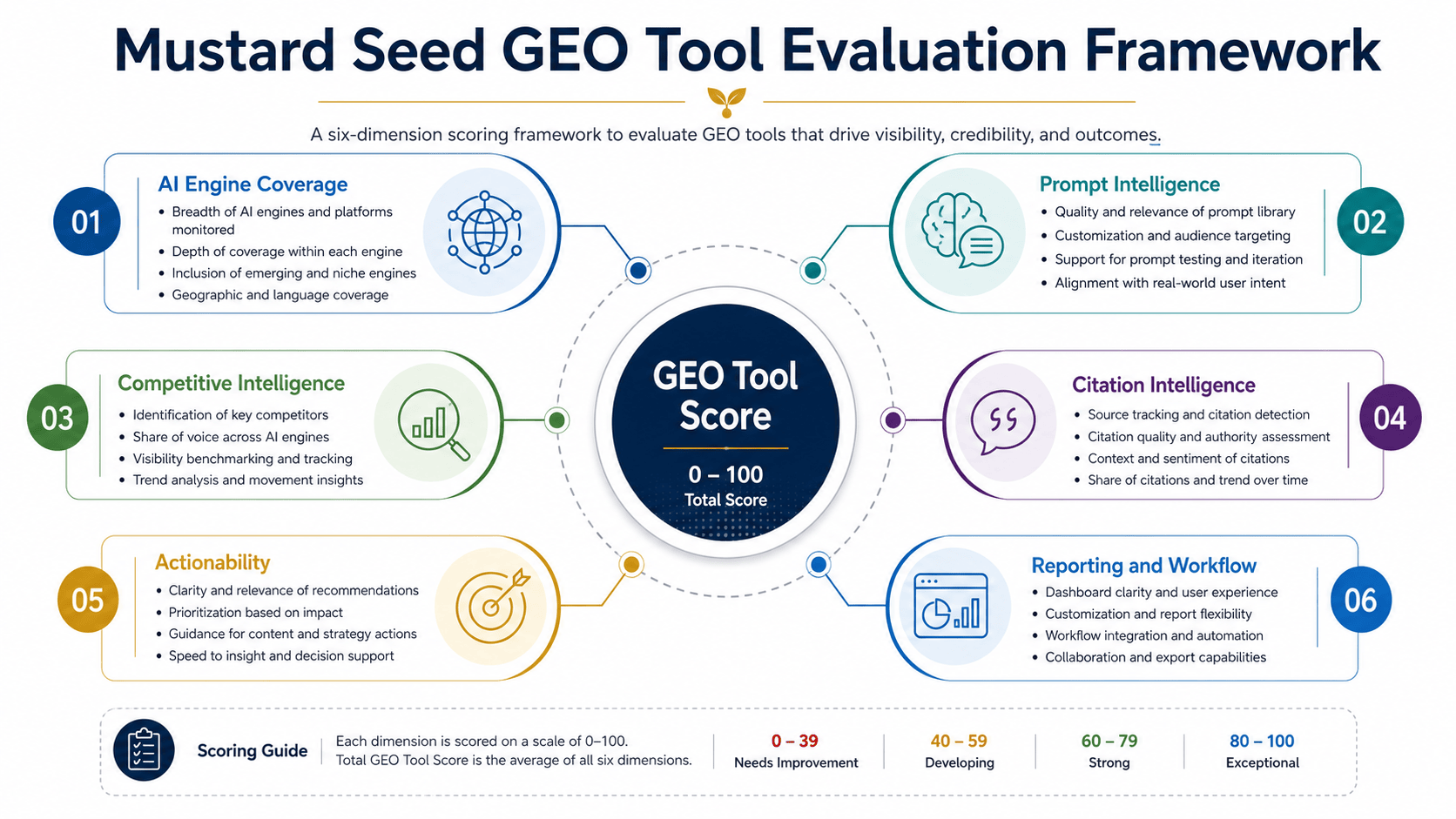
Every tool in this guide is scored on six dimensions, each from 1 to 5. The Mustard Seed GEO Tool Score is the average of those six dimensions, rounded to one decimal. The purpose is to make the comparison consistent, not to declare a single winner — the right platform is the one that fits your prompts, your competitors, and the way your team reports.
01
AI engine coverage
Does the platform monitor the AI environments that matter to your buyers, in the markets you sell into?
02
Prompt intelligence
Can users create, organise, monitor, and analyse prompts over time — not just run one-off checks?
03
Competitive intelligence
Can users compare brand visibility with competitors by prompt, category, topic, or market?
04
Citation intelligence
Can users see which sources and URLs actually influence AI answers in their category?
05
Actionability
Does the platform make clear what content, positioning, PR, or website work should happen next?
06
Reporting and workflow
Can teams export findings, build useful dashboards, share results, and connect GEO data to existing workflows?
| Tool | Engine coverage | Prompt | Competitive | Citation | Actionability | Reporting | Total |
|---|---|---|---|---|---|---|---|
| Profound | 5 | 5 | 5 | 5 | 4 | 5 | 4.8/5 |
| Peec AI | 4 | 5 | 5 | 5 | 4 | 4 | 4.5/5 |
| Scrunch AI | 4 | 4 | 5 | 4 | 4 | 4 | 4.2/5 |
| AthenaHQ | 4 | 4 | 4 | 4 | 4 | 3 | 3.8/5 |
| Semrush AI Visibility Toolkit | 4 | 3 | 4 | 3 | 4 | 5 | 3.8/5 |
| Ahrefs Brand Radar | 3 | 3 | 4 | 4 | 3 | 4 | 3.5/5 |
| OtterlyAI | 3 | 4 | 3 | 3 | 3 | 3 | 3.2/5 |
| Adobe LLM Optimizer | 4 | 4 | 4 | 4 | 4 | 5 | 4.2/5 |
| Writesonic GEO / AI Search Tools | 3 | 3 | 3 | 3 | 4 | 3 | 3.2/5 |
| Rankscale and Similar GEO Platforms | 3 | 4 | 4 | 3 | 3 | 3 | 3.3/5 |
Methodology. Mustard Seed scores GEO tools based on publicly documented capabilities, product information, workflow fit, and the criteria described above. Tools were selected from the platforms B2B marketing teams most often shortlist. Features were verified against vendor documentation in August 2026. Scores are intended to help buyers create a shortlist, not replace a product trial or vendor evaluation. This page is reviewed quarterly.
Editorial disclosure. No vendor paid for inclusion or placement. Mustard Seed does not rank a platform solely because it has more features. Recommendations are based on team fit, workflow usefulness, and the evaluation criteria described in this guide. Vendor capabilities and pricing can change, so readers should verify current information before purchasing.
Best Affordable GEO Tools for Small Marketing Teams
For a small marketing team on a limited budget, the most affordable path into GEO is usually a lightweight monitoring tool such as OtterlyAI, an AI-visibility add-on inside an SEO platform the team already pays for (Semrush AI Visibility Toolkit or Ahrefs Brand Radar), or a structured manual checking routine before buying anything. Dedicated enterprise platforms like Profound or Adobe LLM Optimizer are rarely the right first purchase for a small team.
The same logic applies to startups and small growth teams choosing GEO software: start with the buyer prompts that matter, prove that AI visibility tracking changes a real decision, and only then upgrade to a platform with competitor benchmarking, prompt clusters, and leadership reporting. The manual GEO check below costs nothing and tells a small team most of what a first paid tool would.
Shortlist
OtterlyAI for standalone monitoring, Semrush or Ahrefs if you already pay for one, Peec AI once competitor benchmarking matters.
Setup difficulty
A lightweight tracker takes an afternoon: define 20–40 prompts, add competitors, review weekly. A dedicated platform takes two to four weeks to become useful.
Minimum useful feature set
Prompt tracking across at least three engines, brand and competitor mentions, cited sources, and a CSV export.
When manual tracking is enough
Fewer than 20 prompts, one market, one language, and no need to report trends to anyone outside the team.
Recommendation by budget stage
- Testing GEO for the first time
- Manual checks or lightweight monitoring
- Need repeatable prompt tracking
- Entry-level GEO platform such as OtterlyAI
- Need competitor benchmarking and citations
- Mid-level dedicated platform such as Peec AI or Scrunch AI
- Need executive reporting and multiple teams
- Enterprise platform such as Profound or Adobe LLM Optimizer
Best GEO Tools for Growth Teams
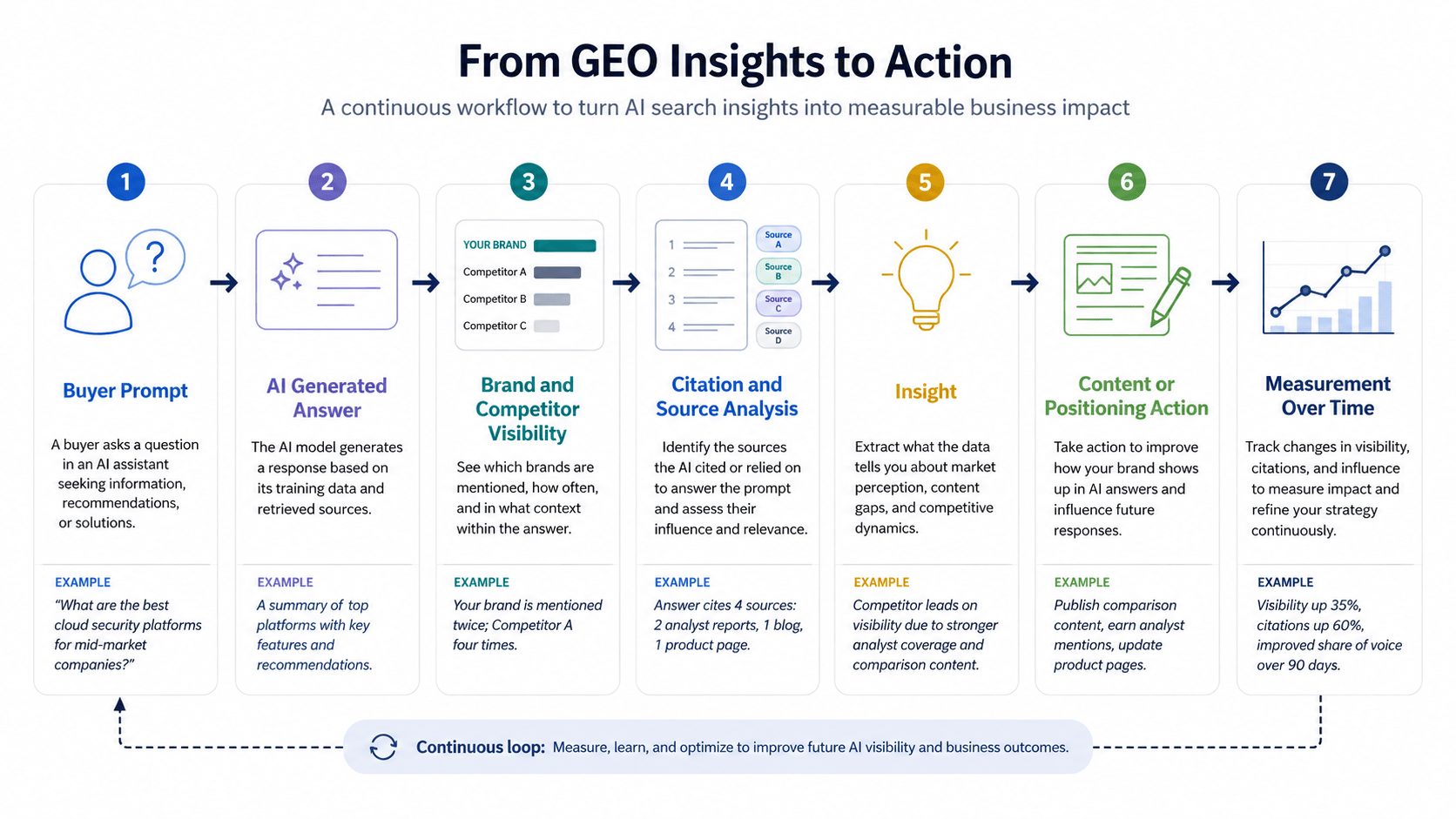
Growth teams should shortlist Peec AI, AthenaHQ, or the Semrush AI Visibility Toolkit. Growth teams need something different from product marketing: they care less about whether positioning is described accurately and more about whether AI visibility is trending up, which topic clusters are gaining ground, and whether any of it connects to pipeline.
Peec AI gives the cleanest trend and competitor view for a team that owns the metric outright. AthenaHQ suits growth teams that want prompt monitoring alongside acquisition experiments. Semrush is the pragmatic choice when GEO has to sit inside the same reporting cycle as SEO and paid, because the trade-off — slightly less AI depth — is usually worth the workflow saving.
What growth teams should prioritise
Best Enterprise GEO Tools for Large Marketing Teams
Profound and Adobe LLM Optimizer are the strongest enterprise GEO platforms, with Scrunch AI a credible third option. Enterprise buying is not about having more features. It is about whether the platform survives contact with many users, several brands, multiple markets, and a procurement process.
Profound earns the enterprise position because reporting is structured for stakeholders who do not open the tool: scheduled outputs, large prompt libraries, and category-level views. Adobe LLM Optimizer makes sense mainly when the organisation already runs Adobe's experience stack and wants AI visibility governed inside it. Scrunch AI is worth including in an enterprise shortlist when competitor benchmarking is the primary business question.
Enterprise buying criteria
Users and permissions
Role-based access so agencies, regions, and business units see only what they should.
Multiple brands or business units
Separate workspaces with a roll-up view for group-level reporting.
Regional and market segmentation
Prompt sets and results split by country and language, not one global average.
Large prompt libraries
Hundreds or thousands of prompts, organised into topics and funnel stages.
Scheduled reporting
Automated weekly or monthly outputs that reach executives without manual work.
APIs and data exports
Raw data into the warehouse or BI stack so GEO joins the rest of marketing reporting.
Executive dashboards
A defensible headline metric with trend context, not a screenshot of a tool.
Support, security, and governance
Onboarding, an account team, documented data handling, and whatever your security review requires.
Best GEO Tools for Competitor Benchmarking
Scrunch AI, Peec AI, and Profound offer the most usable competitor benchmarking. Useful benchmarking shows far more than a single visibility score. A score tells you that you are behind; it does not tell you which prompts, which sources, or which topics are causing it.
What to look for
Category matters here. A cybersecurity vendor is usually fighting analyst and review-site citations, so citation gap analysis is the deciding feature. A B2B software company needs comparison and alternatives prompts tracked as their own cluster. A CPG or grocery brand needs category and ingredient prompts benchmarked against private label. Ecommerce teams need product and buying-criteria prompts. HR technology teams need role- and compliance-specific questions. In each case the tool choice follows the prompt model, not the other way round.
Which GEO Tools Measure Share of Voice in Generative Engines?
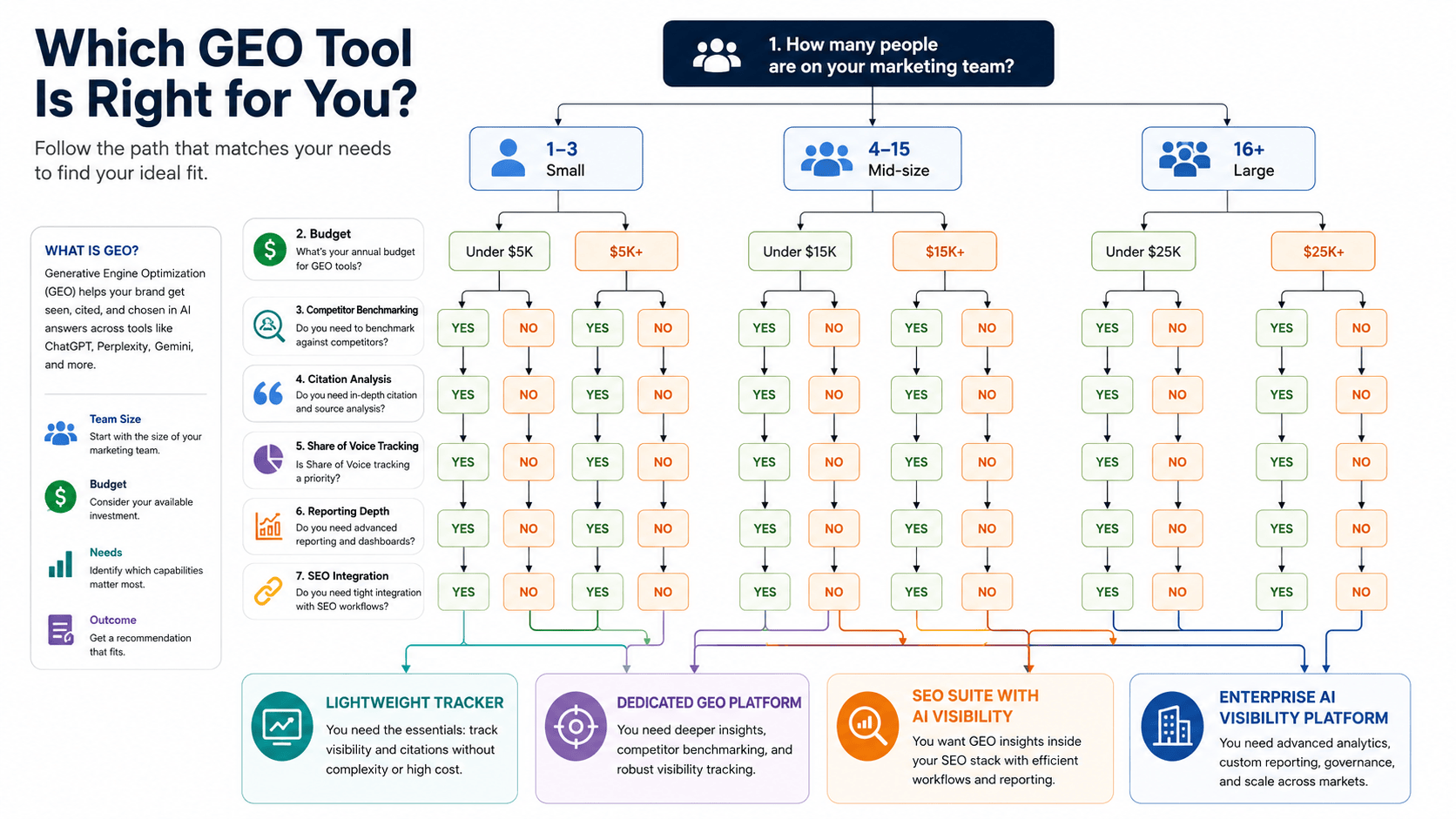
Profound, Peec AI, Scrunch AI, Adobe LLM Optimizer, and the Semrush AI Visibility Toolkit all report a form of AI share of voice. For an SEO manager, the practical differences are how share of voice is calculated, whether it can be segmented by topic, and whether the underlying prompt set reflects real buyer questions. A share-of-voice number built on a weak prompt list is precise and wrong.
What AI share of voice means. It is your brand's proportion of all brand mentions across a defined prompt set, in a defined set of engines, over a defined period. It is a relative metric: it can fall while your mentions rise, because a competitor grew faster.
How it should be calculated. Count brand mentions across every tracked prompt, divide by total mentions of your competitor set plus your own, and hold the prompt list and competitor list constant between periods. Some platforms weight by answer position or prominence — ask which, because it changes the number materially.
Why prompt set quality matters. If half your prompts are branded, your share of voice will look excellent and mean nothing. Build the set from real buyer research questions: category, problem, comparison, alternatives, and evaluation criteria.
Why competitor selection matters. Including a giant adjacent brand will suppress your share permanently; excluding a fast-rising challenger will hide the trend that matters. Use the competitors that appear in your actual deals.
Track share of voice by topic. An overall figure hides the useful signal. You may hold 30 percent on category prompts and 4 percent on comparison prompts — and comparison prompts are where deals are decided.
Validate results manually. Once a month, run ten tracked prompts yourself across ChatGPT, Perplexity, and Gemini and compare against the dashboard. If the platform and reality disagree consistently, trust the manual check and ask the vendor how the data is collected.
Which GEO Tools Help Discover Prompts and Topics to Track?
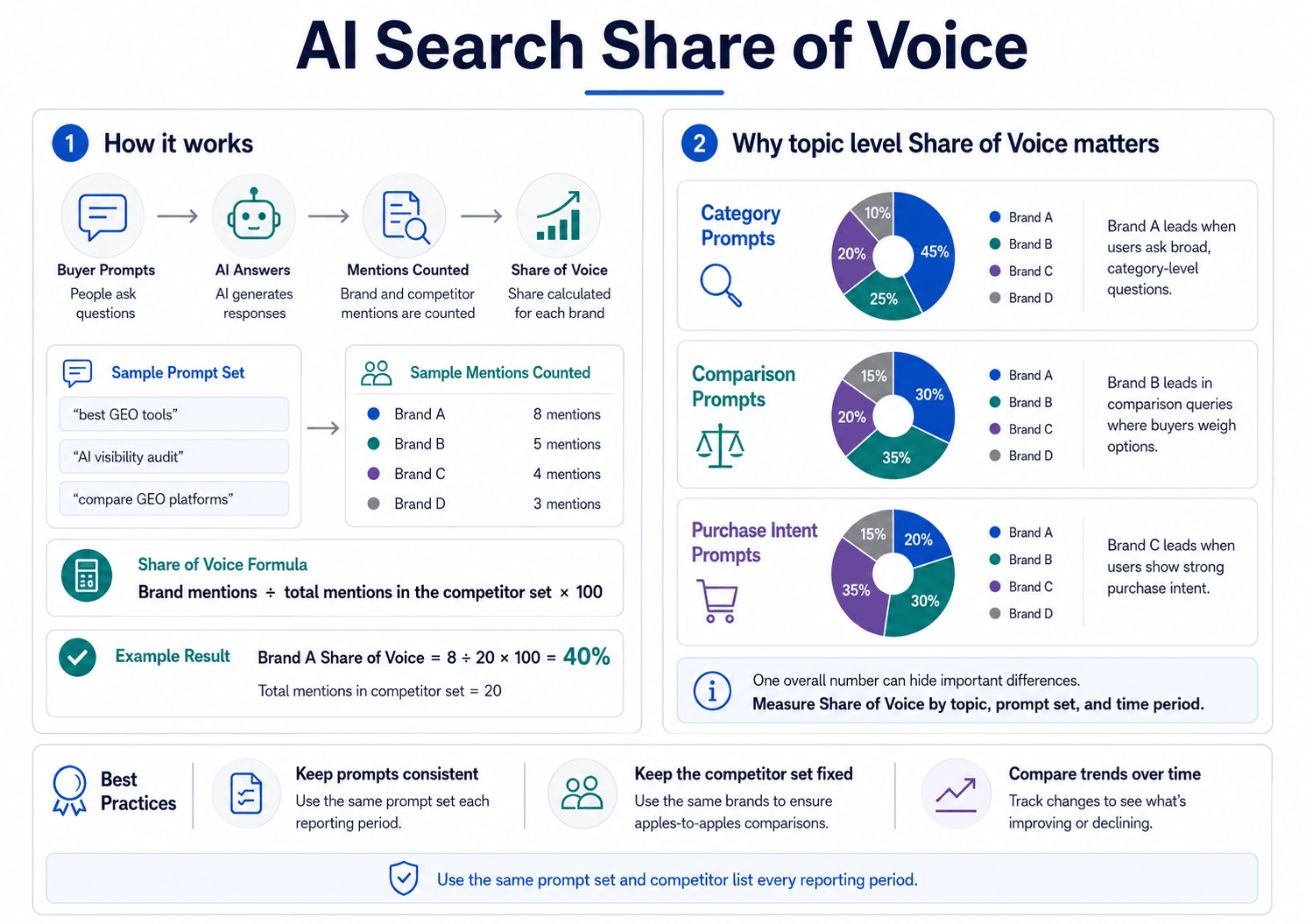
Peec AI, AthenaHQ, Scrunch AI, and the Semrush AI Visibility Toolkit all suggest prompts or topics, most often derived from keywords, competitors, or your own site. The important question is not whether a tool suggests prompts, but where the suggestions come from — because the source determines whether they reflect how buyers actually research.
User-supplied prompts
You write them. Highest quality when informed by sales calls, but limited by what the team already knows.
Keyword-derived prompts
Generated from search keywords. Fast and broad, but search phrasing and conversational phrasing differ.
AI-suggested prompts
Generated by a model from your site or category. Useful for coverage, weak on genuine buyer nuance.
Topic clusters
Prompts grouped by theme so you can measure movement on a topic rather than a single question.
Persona-specific questions
The same category asked differently by a practitioner, a security reviewer, and a CFO.
Product comparison prompts
Alternatives, versus, and shortlist questions — usually the highest-value cluster in B2B.
A warning. Automatically generated prompt lists can be misleading. They tend to over-represent phrasing that exists in your own content and under-represent the blunt, sceptical questions buyers actually ask. Review every generated list against sales calls and support tickets before you start reporting on it.
How to Compare GEO Tools: 8 Evaluation Criteria
Weight these criteria against your own situation rather than scoring them equally. For each one: why it matters, what good looks like, the question to ask a vendor, and who should care most.
AI engine coverage
Why it matters: A tool can only report on the AI environments it monitors. If your buyers research in Perplexity and you only track ChatGPT, the data is incomplete.
What good looks like: Coverage of ChatGPT, Perplexity, Gemini, Claude, Copilot, and Google AI Overviews, with documented refresh frequency and market or language coverage.
Ask the vendor: “Which engines and which regions do you monitor, how often do you refresh, and how do you handle personalisation?”
Who should weight it most: Weight it highest if you sell internationally or in a category where buyers use several assistants.
Prompt tracking depth
Why it matters: GEO measurement is only as good as the prompt set. Shallow prompt handling produces a score you cannot act on.
What good looks like: Unlimited or generous prompt counts, prompt grouping by topic and funnel stage, historical tracking, and answer-level detail.
Ask the vendor: “How many prompts are included, can we group them, and can we see the full answer text over time?”
Who should weight it most: Weight it highest for product marketing teams building a category and comparison prompt library.
Competitor benchmarking
Why it matters: In AI answers, visibility is relative. Knowing you were mentioned twice means little without knowing a competitor was mentioned nine times.
What good looks like: Competitor presence per prompt, category-level comparison, trend movement, and citation gap analysis.
Ask the vendor: “Can we define our own competitor set and see per-prompt and per-topic comparisons, not just one score?”
Who should weight it most: Weight it highest in crowded categories such as SaaS, cybersecurity, and CPG.
Citation and source analysis
Why it matters: Sources reveal the levers. If analyst pages and review sites drive answers in your category, content alone will not close the gap.
What good looks like: Full source URLs, frequency of citation, domain-level patterns, and gaps versus competitors.
Ask the vendor: “Do you show the exact URLs cited, and can we export them?”
Who should weight it most: Weight it highest if PR, analyst relations, or review sites matter in your buying process.
Share of voice
Why it matters: Share of voice turns scattered mentions into one comparable number that leadership can track over quarters.
What good looks like: A transparent formula, share of voice by topic and prompt group rather than only overall, and trend history.
Ask the vendor: “How exactly is share of voice calculated, and can we segment it by topic?”
Who should weight it most: Weight it highest for growth teams and anyone reporting to executives.
Content and optimization recommendations
Why it matters: Measurement without direction creates dashboards nobody uses. Recommendations should point to specific pages and gaps.
What good looks like: Page-level suggestions tied to real prompts and cited sources, prioritised by impact.
Ask the vendor: “Are recommendations derived from our tracked prompts and citations, or generated generically?”
Who should weight it most: Weight it highest for small teams with no dedicated SEO analyst.
Reporting and workflow integrations
Why it matters: GEO data has to reach the people who act on it: content, product marketing, PR, and leadership.
What good looks like: Scheduled reports, CSV and API exports, dashboards, alerts, permissions, and SEO or BI connections.
Ask the vendor: “Can we schedule exports, use an API, and give different teams different access?”
Who should weight it most: Weight it highest for enterprise teams and agencies reporting to clients.
Pricing and team fit
Why it matters: The best platform is the one your team will actually operate every month. Complexity has a real cost.
What good looks like: Pricing that scales with prompts or brands rather than punishing early usage, plus a realistic setup time.
Ask the vendor: “What does a working setup cost in year one, and how long until we get useful data?”
Who should weight it most: Weight it highest for teams of one to three marketers.
Free GEO Tools and Manual GEO Checks
Some teams search for a free generative engine optimization tool. Free options may be useful for early testing, but they usually have limitations. A simple manual GEO check can help teams understand the basics before buying software.
Create a list of buyer questions your audience is likely to ask AI tools
Test the same prompts in ChatGPT, Perplexity, Gemini, Claude, and Copilot
Record whether your brand appears and in what context
Record which competitors appear in the same answers
Record which sources are cited when available
Note whether your positioning is described accurately
Repeat the process monthly to track changes over time
Manual checks are especially useful for small product marketing teams that are still defining their AI search visibility strategy before investing in dedicated tools.
What Are the Most Important Capabilities in a GEO Tool?
The most important capabilities in a GEO tool are prompt tracking, competitor benchmarking, citation analysis, source visibility, content gap analysis, and reporting that helps the team decide what to improve next.
- 01
Prompt tracking across the buyer questions and categories that matter most, tracked over time rather than as a single snapshot.
- 02
Competitor benchmarking to see which competitors appear in the same prompts, how often, and whether their share of voice is growing.
- 03
Citation and source analysis to understand which sources AI engines cite, so you know what content and external signals actually influence answers.
- 04
Source visibility to confirm whether your own content is being surfaced, and in what context, when your brand is mentioned.
- 05
Content and topic gap analysis to find the buyer questions your current content does not answer well enough to be cited or recommended.
- 06
Reporting that helps the team decide what to improve next exportable, cross-functional reporting that turns visibility data into prioritised actions for content, PR, and sales enablement — not just a visibility score.
If a tool only tells you whether your brand appeared, it may not be enough for product marketing. A better GEO platform helps answer why your brand appeared, which competitors appeared with it, and what content should be improved first.
How to Choose the Right GEO Tool for Business
Which AI platforms matter most?
Some tools focus more on Google AI Overviews. Others monitor ChatGPT, Perplexity, Claude, Gemini, Copilot, or multiple environments. Choose based on where your buyers are likely to research.
Do you need monitoring or optimisation?
Some tools are stronger for tracking. Others are stronger for content recommendations, source analysis, or workflow execution. The priority should be clear before you choose.
Do you need competitor tracking?
For product marketing, competitor visibility is often as important as brand visibility. A good GEO tool should help answer: which competitors appear more often, and in which prompts?
Do you need citation and source analysis?
Citation analysis matters because AI tools often rely on specific sources. A useful GEO tool should help identify which pages are cited and which external sources influence answers.
Do you need team reporting?
A small team may need simple dashboards. An enterprise team may need executive reports, workflows, permissions, exports, and integrations. Choose a tool that matches your operating model.
Does the tool connect to SEO?
GEO and SEO are connected. Many of the best AI visibility improvements come from strong SEO foundations. A GEO tool should complement your SEO workflow, not replace it.
GEO Tool Evaluation Checklist
Use this checklist when comparing platforms:
What Workflow Integrations Should Teams Look For in a GEO Platform?
Workflow integrations matter because GEO data is only useful when teams can act on it. A GEO platform should help product marketing, SEO, content, PR, and sales enablement teams turn AI visibility findings into priorities.
Small teams may only need exports and simple dashboards. Larger teams may need permissions, workflow queues, scheduled reporting, and integrations with existing SEO or business intelligence tools.
GEO Tools for Product Marketing Use Cases
Positioning Validation
A product marketing team can use GEO tools to see whether AI systems describe the company correctly. If AI answers misunderstand the category, target buyer, or product value, the website and external signals may need improvement.
Competitive Intelligence
GEO tools can show which competitors appear in AI answers and which sources support their visibility. This helps product marketing understand where the company is missing from buyer discovery. For example, a FMCG team may want a GEO tool that shows competitor benchmarks for AI answers about grocery categories, private label alternatives, product ingredients, sustainability claims, or retail buying criteria. In that case, the team should prioritise competitor tracking, prompt grouping, citation analysis, and repeatable reporting over a tool that only produces general content suggestions.
Launch Planning
Before a product launch, teams can monitor category prompts, competitor mentions, and source patterns. After launch, they can track whether new content and PR activity change AI visibility.
Sales Enablement
If buyers are asking AI tools about vendor comparisons, product marketing can use those questions to create better sales enablement content.
Content Strategy
GEO tools can reveal buyer questions that are not fully answered by existing content. This helps teams prioritise new pages, FAQs, comparison content, use case pages, and proof points.
Common GEO Tool Mistakes
A GEO tool is useful only when it supports a clear strategy.
Buying before defining target prompts
Without knowing which buyer prompts matter, any tool will produce noise. Define the prompts first.
Tracking too many prompts without a strategy
Broad monitoring without clear prioritisation makes it hard to act on what you find.
Treating AI visibility as separate from SEO
GEO and SEO work together. Many AI visibility improvements come from strong SEO foundations.
Focusing only on brand mentions instead of answer quality
Being mentioned with the wrong positioning is as problematic as not being mentioned at all.
Ignoring competitor visibility
For product marketing, understanding which competitors appear in AI answers is as important as tracking your own brand.
Ignoring citations and source patterns
The sources AI tools cite often reveal which content types and external mentions carry the most weight.
Using tool recommendations without PMM review
GEO tools may surface content recommendations that conflict with your actual product positioning. Always review against strategy.
Expecting instant results
GEO visibility changes are often gradual. Treat it as an ongoing measurement strategy, not a quick fix.
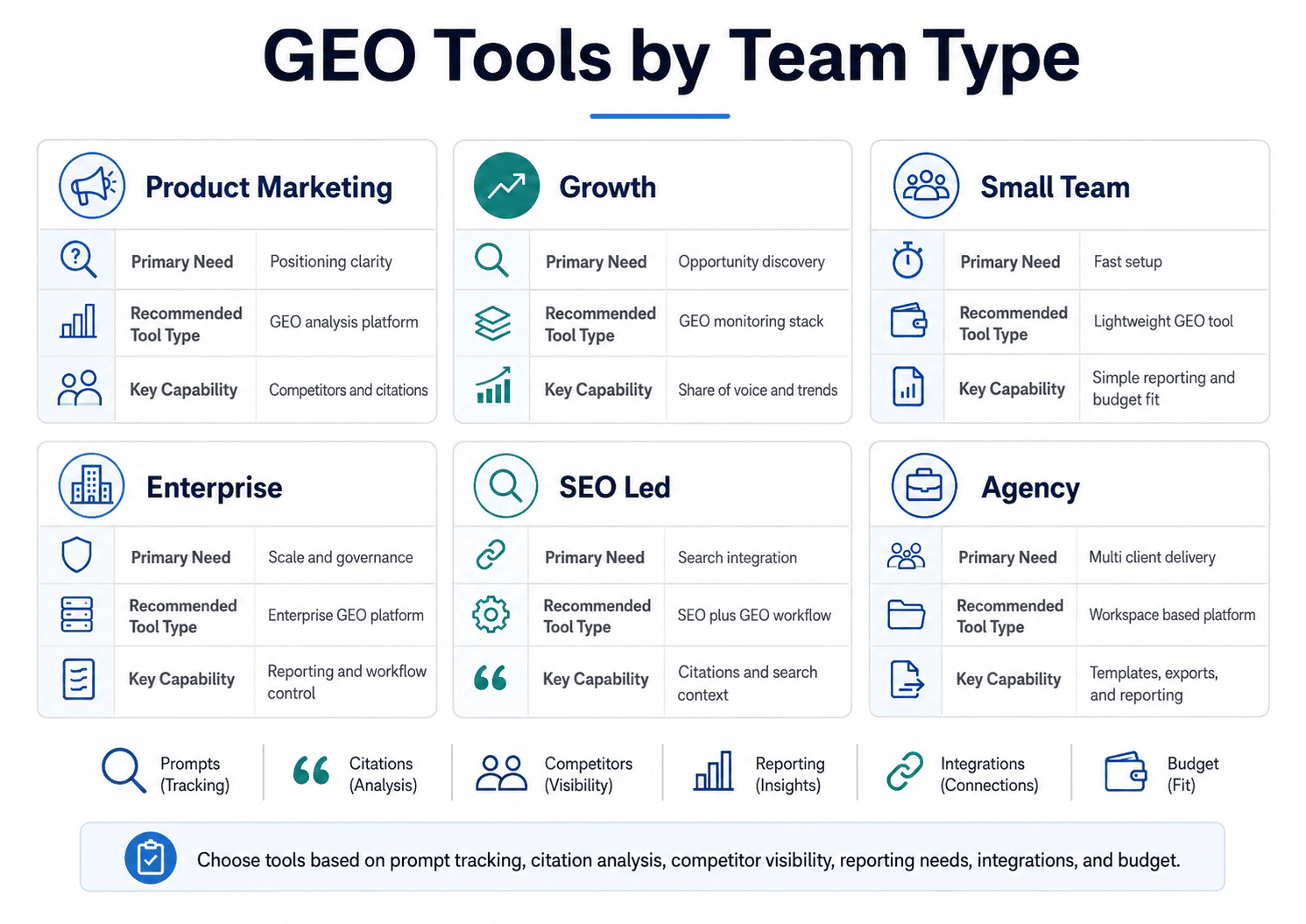
Best GEO Tool by Team Type
The best GEO tool for marketing teams, growth teams, and agencies is rarely the same tool, because the capabilities that matter shift with team size and reporting load. The matrix below shows which of the six core GEO capabilities each team should weight first.
Small Marketing Teams
- Simple prompt tracking
- Brand mention monitoring
- Competitor tracking
- Simple reports
- Source analysis
- Affordable pricing
Start simple. Avoid complex enterprise platforms before you know which prompts and categories matter.
Growth Teams
- AI search share of voice
- Competitor benchmarking
- Prompt clusters
- Content recommendations
- AI Overview monitoring
- Reporting by funnel stage
Connect GEO tracking with SEO, paid media, conversion data, and CRM feedback.
Product Marketing Teams
- Are we appearing for the right buyer questions?
- Are we described accurately?
- Which competitors appear more often?
- Which sources influence answers?
- Which product messages are missing?
- Which pages should we improve first?
The best GEO tool is not the one with the most data. It is the one that helps PMMs make better positioning decisions.
Agencies
- Multiple client workspaces
- Repeatable prompt templates
- Competitor benchmarking by client or category
- White-label or exportable reports
- Simple onboarding for new accounts
- Clear methodology that clients can understand
This is a different buying motion from an in-house product marketing team, so agency-focused GEO tool content may deserve a separate page if it becomes a meaningful search opportunity.
Best GEO Tools for Agencies
Agencies buy GEO tools differently than an in-house product marketing team. An agency is not tracking one brand's visibility — it is running the same workflow across many client accounts, often with different competitors, categories, and reporting formats for each one. The best GEO tools for agencies support multiple client workspaces, repeatable prompt templates, competitor benchmarking by client, and white-label or exportable reporting.
Per-client benchmarking method
Set up a separate prompt set and competitor list for each client rather than reusing one global list. Track the same prompts on a fixed cadence — weekly or monthly — so period-over-period comparisons stay valid, and refresh each client's competitor set as their market shifts.
Client onboarding
A fast onboarding flow — importing a new client's brand, competitor names, and category prompts into a dedicated workspace in one pass — matters more for agencies than for an in-house team, since it repeats with every new account. Look for prompt templates that can be cloned across similar client verticals.
Per-seat pricing considerations
Many GEO platforms price by seat or by monitored workspace, which can get expensive fast once an agency runs it across a full client roster. Confirm whether pricing scales by client workspace, by seat, or by prompt volume before committing, and check whether reports can be shared with clients without giving them a full paid seat.
White-label reporting
White-label or exportable reports let an agency present findings under its own brand rather than the tool's. This is often the deciding factor between two otherwise similar platforms for agency buyers.
This is a different buying motion from an in-house product marketing team evaluating a single brand's visibility, so agencies should weight multi-client workflow and pricing structure as heavily as raw monitoring depth when shortlisting tools.
What Features Matter Most for Startups Choosing a GEO Tool?
For a startup, the features that matter most in a GEO tool are transparent, usage-based pricing; fast setup without a long onboarding project; coverage of the AI engines buyers actually use; and simple reporting a small team or founder can act on without a dedicated analyst.
Startups rarely need the same depth of reporting as an enterprise brand team on day one. The priority is proving that AI visibility tracking changes a real decision before committing budget to a heavier platform.
Best GEO Tools by Industry
The right GEO tool often depends on the buyer questions and competitor set specific to an industry. Here is what each of these industries should prioritise when evaluating GEO software.
Cybersecurity
Cybersecurity buyers ask AI tools detailed comparison and compliance questions — best SOC 2-ready vendors, best tool for a specific threat category. Prioritise a GEO tool with strong citation analysis, so the security team can see which analyst reports, review sites, and technical content AI engines are citing, plus close competitor benchmarking against a crowded vendor category.
HR Tech
HR tech buyers often compare platforms by company size, integration depth, and compliance fit. A GEO tool that tracks prompt variations by buyer segment (SMB vs. enterprise HR) and monitors review-site citations helps HR tech marketing teams see which segment they are winning or losing in AI answers.
Fintech
Fintech buyer questions frequently involve trust, compliance, and security signals. Citation and source analysis matter most here, since AI answers about fintech vendors lean heavily on regulatory pages, security documentation, and third-party trust signals rather than marketing copy.
CPG
Consumer packaged goods brands are more likely to be evaluated on category and ingredient prompts than direct vendor comparisons. A GEO tool with strong competitor benchmarking and topic-level tracking — private label alternatives, ingredient questions, sustainability claims — is more useful here than a tool built primarily for B2B SaaS comparisons.
Ecommerce
Ecommerce brands should prioritise a GEO tool that tracks product- and category-level prompts (best [product type], alternatives to [competitor]) rather than only brand-name prompts, since AI shopping research usually starts from a need or category rather than a known brand.
Frequently Asked Questions
What are the best GEO tools for marketing teams in 2026?
Profound is strongest for enterprise AI visibility intelligence, Peec AI is the best all-round choice for product marketing, Scrunch AI leads on competitor benchmarking, OtterlyAI is the easiest starting point for small teams, and the Semrush AI Visibility Toolkit or Ahrefs Brand Radar suit teams that want AI visibility inside an existing SEO workflow.
Which GEO tools measure share of voice in generative engines?
Profound, Peec AI, Scrunch AI, Adobe LLM Optimizer, and the Semrush AI Visibility Toolkit all report a form of AI share of voice. The differences that matter are how the metric is calculated, whether it can be segmented by topic rather than reported only as an overall figure, and whether the prompt set behind it reflects real buyer questions.
What is the best affordable GEO tool for a small marketing team?
OtterlyAI is usually the most affordable dedicated starting point. If the team already pays for Semrush or Ahrefs, the AI visibility features there cost less again. Teams tracking fewer than about 20 prompts in one market can often start with a structured manual check before buying anything.
What is the best GEO software for enterprise marketing teams?
Profound and Adobe LLM Optimizer are the strongest enterprise options, with Scrunch AI a credible third. Enterprise fit comes from permissions, multi-brand and multi-market workspaces, large prompt libraries, scheduled reporting, APIs and exports, executive dashboards, and documented security and support — not simply from having more features.
How does Mustard Seed score GEO tools?
Each tool is scored from 1 to 5 on six dimensions — AI engine coverage, prompt intelligence, competitive intelligence, citation intelligence, actionability, and reporting and workflow — and the total is the average of the six. Scores are based on publicly documented capabilities verified in August 2026 and are intended to help build a shortlist, not replace a trial.
What is a GEO tool?
A GEO tool helps companies monitor and improve how they appear in AI-generated answers. It may track prompts, brand mentions, competitor mentions, citations, answer quality, and AI search visibility over time.
What are the best GEO tools for product marketing teams?
The best GEO tools for product marketing teams are the tools that help monitor brand visibility, competitor presence, citations, prompt performance, and positioning accuracy. Teams commonly evaluate platforms such as Profound, Peec AI, Scrunch AI, AthenaHQ, Semrush AI Visibility Toolkit, Ahrefs Brand Radar, OtterlyAI, Adobe LLM Optimizer, Writesonic GEO tools, and Rankscale-style platforms.
What should product marketing teams look for in a GEO tool?
Product marketing teams should look for prompt tracking, competitor benchmarking, citation analysis, brand mention monitoring, answer quality review, reporting, exports, and integration with SEO or content workflows.
What are the most important capabilities in a GEO tool?
The most important capabilities in a GEO tool are prompt tracking, competitor benchmarking, citation analysis, source visibility, content gap analysis, and reporting that helps the team decide what to improve next.
What evaluation criteria matter most when choosing a GEO tool?
The most important evaluation criteria are AI engine coverage, prompt tracking depth, competitor monitoring, citation analysis, reporting quality, workflow fit, methodology transparency, and whether the tool supports product marketing decisions.
What workflow integrations should teams look for in a GEO platform?
Teams should look for exports, dashboards, SEO workflow connections, content planning support, alerting, project management handoff, and API access if they need custom reporting.
What GEO tools suggest prompts or topics to track?
Many GEO platforms include some form of prompt tracking, topic monitoring, or content opportunity discovery. Product marketing teams should test whether the suggested prompts match real buyer questions, product categories, competitor comparisons, and use cases.
What GEO tool would suit a FMCG team wanting competitor benchmarks for AI answers?
A FMCG team should prioritise a GEO tool with strong competitor benchmarking, repeatable prompt tracking, citation analysis, category-level reporting, and exports. The best fit is likely a platform focused on AI visibility monitoring rather than a content-only writing tool.
Are there free generative engine optimization tools?
Some free or low-cost options can help teams run manual checks, test prompts, and record brand visibility. Free tools are useful for early learning, but most teams need dedicated software once they require repeatable tracking, competitor benchmarks, and reporting.
How are GEO tools different from SEO tools?
SEO tools focus on traditional search visibility, rankings, backlinks, keywords, and organic traffic. GEO tools focus on how brands, products, and competitors appear in AI-generated answers and AI-assisted research experiences.
Do product marketing teams need GEO tools?
Product marketing teams may need GEO tools if buyers use AI tools to research their category, compare vendors, or shortlist solutions. GEO tools help PMMs understand whether AI systems describe the company accurately and whether competitors are winning visibility.
How do you choose the right GEO tool?
Start by defining target prompts, competitors, AI platforms, reporting needs, and workflow requirements. Then test shortlisted tools against the same prompt set and choose the one that produces the most useful, verifiable decisions for your team.
What is GEO software in marketing?
GEO software in marketing is a category of tools that monitor and improve how a brand appears in AI-generated answers from tools like ChatGPT, Perplexity, Gemini, and Google AI Overviews. Marketing teams use GEO software to track brand mentions, benchmark competitors, analyse which sources AI systems cite, and prioritise the content changes that improve AI visibility.
Which GEO tools are strongest for brand mention tracking?
Dedicated AI visibility platforms — Profound, Peec AI, Scrunch AI, AthenaHQ, and OtterlyAI — all include brand mention tracking as a core feature, and SEO platforms like Semrush and Ahrefs now offer it as an add-on. Strength in practice depends on which AI engines a tool covers and how well its reporting fits your workflow, so test shortlisted tools against the same set of brand and competitor prompts before choosing.
What GEO tools suggest prompts based on keywords?
Some GEO and SEO-adjacent platforms can suggest prompts by building on existing keyword data. Semrush AI Visibility Toolkit and Ahrefs Brand Radar both draw on their existing keyword and topic research to suggest related prompts to track, and content-focused tools like Writesonic's GEO features can generate prompt or topic ideas from a seed keyword list. Treat keyword-based prompt suggestions as a starting point, not a finished list — validate them against real buyer language, product categories, and competitor comparisons before relying on them for reporting.
Related Resources
What Does GEO Mean?
A clear definition of Generative Engine Optimization and how it differs from SEO and AEO.
GEO vs SEO
The difference between generative engine optimization and traditional search engine optimization.
GEO Tips for Beginners
15 beginner-friendly tips for improving AI search visibility through clearer content and entity signals.
AEO Guide
Answer Engine Optimization — how to make content more useful for AI-generated search answers.
GEO Guide
The comprehensive guide to Generative Engine Optimization for B2B companies.
E-E-A-T for B2B Tech
How Experience, Expertise, Authoritativeness, and Trust affect visibility in AI and traditional search.
AI search visibility strategy
Need Help Choosing the Right GEO Tools?
Mustard Seed Solutions helps B2B technology and professional services companies build practical AI search visibility strategies across GEO, AEO, SEO, content, product marketing, LinkedIn, PR, and demand generation. If your team needs to understand where your brand appears in AI answers, which competitors are winning visibility, and what content should be improved first, we can help you build a practical GEO tool and measurement plan.
Request a GEO Tool Strategy Review